In today’s fast-moving digital economy, sending money from one bank to another has become a daily necessity for individuals and businesses across Pakistan. Whether it is paying suppliers, settling bills, or transferring money to family, users expect speed, reliability, and security.
This is where IBFT comes in. It is one of the most widely used methods for bank-to-bank transfers in the country. Yet many users still have questions about how it works, how fast it is, what it costs, and whether it is the best option available.
This guide explains everything clearly, from the IBFT meaning to charges, limits, processing time, and better alternatives.
IBFT Meaning and Full Form in Banking
IBFT stands for Interbank Funds Transfer. It refers to the process of transferring money electronically from one bank account to another bank account within Pakistan.
In simple terms, IBFT allows users to send money across different banks without needing to visit a branch. It is part of the broader electronic funds transfer system used by banks to enable digital transactions.
IBFT is commonly used for:
- Sending money to another person’s bank account
- Paying vendors or suppliers
- Transferring funds between personal accounts in different banks
How IBFT Works in Pakistan
IBFT operates through secure banking networks that connect financial institutions across Pakistan. When a user initiates a transfer, the system processes and routes the transaction to the recipient’s bank.
Here is a simple step-by-step process:
Step 1: Enter Recipient Details
The sender enters the beneficiary’s bank account number, bank name, and sometimes IBAN.
Step 2: Choose Transfer Method
The transfer can be done via:
- Mobile banking apps
- Internet banking portals
- ATM machines
Step 3: Confirm Transaction
The sender verifies the amount and confirms the transaction using OTP or a secure PIN.
Step 4: Processing and Settlement
The bank processes the request and transfers funds to the recipient’s bank.
Step 5: Funds Received
Depending on the system and timing, the receiver gets the money instantly or within a few hours.
IBFT Transfer Time in Pakistan
One of the most common concerns is how long IBFT takes.
In most cases:
- IBFT is processed instantly or within a few minutes
- Some transactions may take a few hours depending on the bank
- Delays can occur during weekends or system downtime
Although often referred to as instant bank transfer, IBFT is not always real-time in the strictest sense, especially when compared to newer systems.
IBFT Charges in Pakistan
IBFT fees vary depending on the bank and transaction amount.
Typical scenarios include:
- Small transfers may be free or low-cost
- Larger transactions often incur service charges
- Some banks offer limited free IBFT transactions per month
Common fee-related terms users search for include:
- IBFT charges Pakistan
- interbank transfer fee Pakistan
- bank transfer charges Pakistan
Because fee structures differ across banks, users often check their bank’s latest schedule before making frequent transfers.
IBFT Limits and Restrictions
Each bank in Pakistan sets its own IBFT transfer limits.
Generally:
- Daily transfer limits are imposed
- Per transaction limits may apply
- Limits differ for mobile banking, ATM, and branch transfers
These are often referred to as:
- IBFT limit Pakistan
- maximum transfer limit
- daily transfer ceiling
For businesses or high-volume users, these limits can become restrictive.
IBFT Through Mobile Banking, ATM, and Internet Banking
IBFT is accessible through multiple digital channels:
Mobile Banking
Users can send money instantly using their bank’s app. This is the most commonly used method today.
Internet Banking
Transfers can be initiated through secure web portals provided by banks.
ATM Transfers
Some banks allow IBFT transactions directly from ATM machines.
These options fall under digital banking in Pakistan and have made account-to-account transfers more convenient than ever.
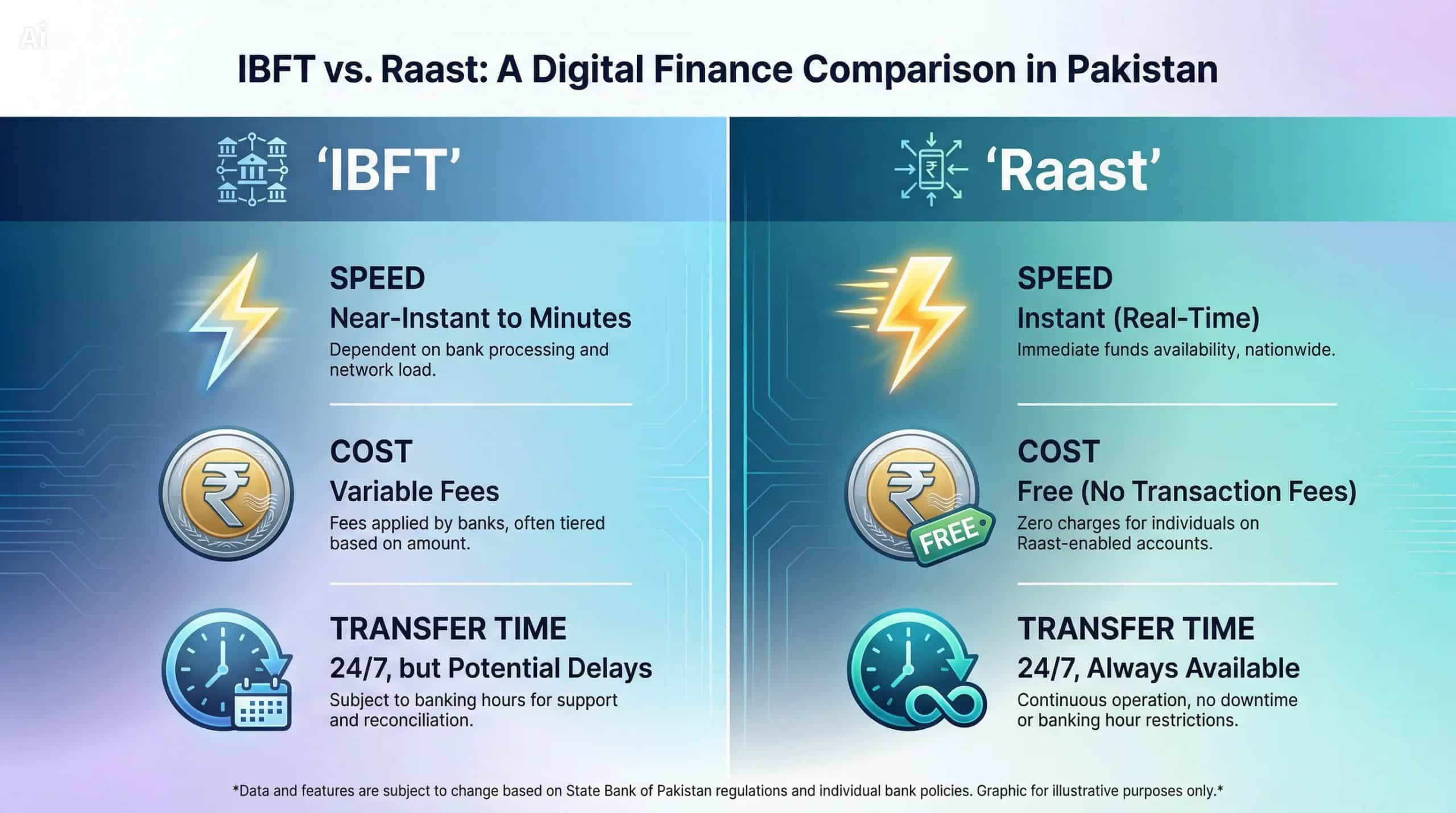
IBFT vs Raast in Pakistan
With the introduction of Raast, many users now compare it with IBFT.
Key differences include:
IBFT
- May involve transaction charges
- Not always fully real-time
- Widely supported across banks
Raast
- Usually free for users
- Designed for instant payments
- Increasing adoption across apps and banks
For users searching for the best way to transfer money between banks in Pakistan, this comparison plays a critical role.
Is IBFT Safe in Pakistan?
Security is a major concern when transferring money online.
IBFT transactions are generally safe because:
- Banks use encrypted systems
- Transactions require authentication such as OTP or PIN
- Financial institutions follow strict regulatory guidelines
However, users should always:
- Double-check account details
- Avoid sharing OTPs
- Use official banking apps only
Common IBFT Problems and How to Fix Them
Despite its reliability, users sometimes face issues.
Transaction Delays
Cause: Bank processing time or system load
Solution: Wait and check transaction status
Failed Transactions
Cause: Incorrect details or network issues
Solution: Recheck details and retry
Payment Not Received
Cause: Delay at receiving bank
Solution: Contact bank support with transaction ID
IBFT Not Working
Cause: Maintenance or downtime
Solution: Try later or use alternative transfer methods
These issues are often searched as:
- IBFT failed transaction
- IBFT delay reasons
- how to track IBFT transaction

A Smarter Way to Send and Collect Money in Pakistan
While IBFT remains widely used, many individuals and small businesses now prefer simpler and more efficient tools to manage their transactions.
This is where Udhaar Book comes in.
Udhaar Book is a digital ledger and payment solution designed for Pakistan. It helps users record transactions, send payment reminders, and manage cash flow in one place.
Instead of relying only on traditional bank-to-bank transfers, users can:
- Track who owes them money
- Record payments instantly
- Simplify collections without confusion
For shopkeepers, freelancers, and small businesses, this creates a smoother experience than managing multiple bank transfers manually.
Final Thoughts
IBFT has played a key role in enabling digital financial transactions across the country. It offers a reliable way to transfer money between banks using mobile apps, ATMs, and online banking.
However, with growing demand for instant, low-cost, and trackable payments, users are gradually exploring better alternatives that combine transfers with financial management.
For anyone looking to not just send money but also stay in control of their finances, tools like Udhaar Book provide a more complete solution.
Download Udhaar Book today to simplify how money is sent, received, and managed in Pakistan.
FAQs
1. What is IBFT in Pakistan?
IBFT stands for Interbank Funds Transfer. It allows users to transfer money from one bank account to another within Pakistan.
2. How long does IBFT take in Pakistan?
Most IBFT transactions are completed instantly or within a few minutes, though some may take longer depending on the bank.
3. Is IBFT free in Pakistan?
Some banks offer free IBFT transactions, but others may charge a fee depending on the amount and frequency.
4. What is the IBFT transfer limit in Pakistan?
Transfer limits vary by bank and channel, including mobile apps, ATMs, and internet banking.
5. Can IBFT transactions be reversed?
Reversal is not guaranteed. Users must contact their bank immediately if a mistake occurs.
6. Is IBFT safe for sending money?
Yes, IBFT is secure when used through official banking channels with proper verification.
7. What is the difference between IBFT and Raast?
IBFT may involve fees and is not always instant, while Raast is designed for real-time, often free transfers in Pakistan.